jeudi 2 octobre 2014

Implant Laboratory Procedures: A Step-by-Step Guide


Implant Laboratory Procedures: A Step-By-Step Guide provides its readers with a systematic and practical approach to the common dental laboratory procedures associated with implant restorative dentistry. Written with laboratory technicians and restorative dentists in mind, the book is organized by case type, taking common case scenarios and devoting a separate chapter to each one in turn, demonstrating each step of the laboratory procedure required for the implant restoration. Complications associated with the various prosthetic procedures are also included in each chapter and work orders are shown for each and every step. Cases are illustrated with products from various implant companies, but predominantly feature products from Biomet 3i.
Implant Laboratory Procedures: A Step-By-Step Guide offers a useful, pragmatic, and helpful approach to the laboratory aspects of implant dentistry. Focusing on step-by-step explanations of procedures, it also contains a wealth of other useful information, such as terminology and background of the modality. Highly illustrated with clinical and laboratory photographs and diagrams, it will provide dental technicians with a comprehensive guide to implant dentistry, and also allow both restorative dentists and implant surgeons to gain additional insights into dental laboratory procedures.


mardi 9 septembre 2014

Esthetic Rehabilitation in Fixed Prosthodontics Vol.1 et Vol.2


   The first volume provides the clinician with a systematic approach to facial evaluation during
esthetic treatment planning. Each chapter guides the reader to an understanding of a different esthetic parameter involved in facial, dentolabial, phonetic, dental, and gingival analysis. An aesthetic check list allows the clinician to apply the principles described in the text to everyday practice.
Amply illustrated, this popular book is an invaluable tool for all clinicians practicing esthetic
and restorative dentistry.


The second voulume presents the procedural phases required to achieve optimal results in the esthetic rehabilitation of patients in need of fixed prostheses.
Communication between the clinician and the technician, which is essential to the esthetic, biologic,
and functional integration of the prosthetic rehabilitation, is highlighted through a step-by-step
presentation of all clinical and laboratory procedures.
Chapters demonstrate methods to obtain accurate facebow recordings, impression materials and techniques, fabrication of provisional restorations, and incorporation of interdisciplinary therapies for ideal comfort and esthetics.
Hundreds of full-colour clinical photographs and detailed illustrations accompany each treatment phase and situation. This beautiful book picks up where Volume 1 ended and delivers its message with equal clarity and precision.


dimanche 7 septembre 2014

Interceptive Orthodontics: A Practical Guide to Occlusal Management


Interceptive Orthodontic saims to guide the practitioner in the art of interceptive management of the developing dentition. The goal is to guide the permanent dentition into the line of the dental arches, avoiding complex orthodontic treatment for teeth displaced far from their ideal position, and thereby reducing orthodontic treatment time.  This book covers growth of the jaws and tooth development, and explains the correct timing of interceptive management. It also discusses orthodontic assessment, special investigations and comprehensive management of the mixed dentition, taking in the issues of early crowding, impaction, supernumerary and supplemental teeth, dental arch expansion, space maintenance and space management. In line with best available evidence, it provides clear treatment objectives and detailed treatment planning advice.
Practical, accessible and illustrated with a wealth of colour images, this is an ideal clinical companion for general dental practitioners, oral surgeons, paediatric dentists and orthodontists. It is also a valuable reference for all training grades.

vendredi 13 juin 2014

La pratique de l'analgésie en odontologie


La réalisation d'une infiltration analgésique fait partie de la pratique quotidienne des chirurgiens-dentistes. Le choix de la solution analgésique en fonction du patient et de l'acte est la première étape, qui conditionne la réussite du soin.

Le matériel actuellement disponible est encore trop pléthorique. Le choix de la technique ne doit pas sacrifier aux modes du moment en faisant appel à des moyens contestables. La technique choisie doit répondre aux contraintes physiologiques, anatomiques locales ainsi qu'à l'âge du patient et du type et de la durée de l'acte envisagé.

Une bonne connaissance anatomique des sites d'injection est capitale pour la réalisation d'un geste efficace et indolore.

Depuis le choix de la molécule et du matériel à la réalisation de chaque technique analgésique, l'objectif de ce manuel est de guider les praticiens, pour éviter les échecs et des techniques discutables, et souvent onéreuses.


mercredi 19 mars 2014

Medical Problems in Dentistry, 6th Edition


This text offers an authoritative account of general medical and surgical conditions as they apply to the practice of dentistry and oral healthcare. Now established as the standard reference on the subject, Medical Problems in Dentistry is essential for students learning for the first time or practitioners needing to keep up-to-date with their knowledge. In this 6th edition, the content has been rewritten and refocused to place even stronger emphasis on the medical problems that directly influence dental practice. All content has been reviewed by a specialist Advisory Board to ensure complete accuracy and currency of information.

Orthodontie de l'enfant et du jeune adulte -Tome 2: Traitements des dysmorphies et malocclusions


Le premier tome de cet ouvrage détaillait l’approche diagnostique et l’élaboration du plan de traitement puis présentait l’arsenal thérapeutique dont dispose aujourd’hui le praticien dans sa pratique orthodontique quotidienne (thérapeutiques orthopédiques, orthodontiques multi-attaches, chirurgico-orthodontiques).
Vous trouverez, dans ce second tome, leurs applications pratiques dans la thérapeutique des principales malocclusions et dysmorphies rencontrées, clairement explicitées et illustrées de près de 50 cas cliniques détaillés et richement iconographiés.
Les caractéristiques diagnostiques et évolutives de chaque malocclusion sont rappelées avant la présentation des différentes approches thérapeutiques spécifiques.


dimanche 16 mars 2014

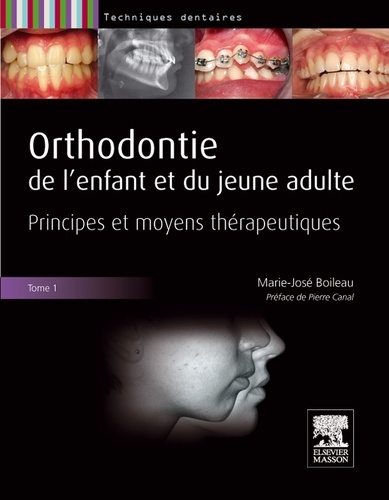
Orthodontie de l'enfant et du jeune adulte


Détecter dès le plus jeune âge les malocclusions et les dysfonctions qui provoquent des répercussions plus ou moins sévères sur la croissance et l'équilibre de la sphère oro-faciale est indispensable. Aujourd'hui, le praticien dispose d'un arsenal thérapeutique élaboré qui lui permet de répondre, au moment opportun, aux différents problèmes rencontrés dans sa pratique orthodontique quotidienne : malpositions, malocclusions, dysmorphies... La qualité et la précision du diagnostic sont des facteurs essentiels à la réussite de ces traitements. Il repose sur un examen clinique systématisé et sur l'analyse rigoureuse des examens complémentaires. Après la description du bilan pré-thérapeutique (examens cliniques et complémentaires, synthèse diagnostique, évaluation psychologique), cet ouvrage analyse les critères à prendre en compte dans l'établissement du plan de traitement et présente les moyens thérapeutiques à la disposition du praticien : thérapeutiques orthopédiques, thérapeutiques orthodontiques multi-attaches, thérapeutiques chirurgico-orthodontiques. Destiné à éclairer les praticiens dans le choix de traitements orthodontiques adaptés, cet ouvrage, illustré par plus de 500 photographies et cas cliniques, rappelle les principes de nombreuses techniques, avec leurs possibilités et leurs limites. Il s'adresse particulièrement aux chirurgiens-dentistes et stomatologistes intéressés par l'ODF et aux étudiants en odontologie ou en orthodontie mais aussi aux spécialistes en orthopédie dentofaciale.